

Nothing at night seems familiar,
the night jars fill my heart,
in a darkness unimagined
the questions slowly start.
Nothing at night seems familiar,
the stars are cast under a spell,
if this land could speak in this empty night,
what stories might it tell?
Nothing at night seems familiar,
My plough is broken and lost,
I search for sweet Cassiopeia,
drowned on the seas that we crossed.
Nothing at night seems familiar,
but by day, these shells at my feet,
are the same that I saw through the vineyard,
where the roads to the mountain meet.
But nothing at night is familiar.
Mired in this damp earth
I stand on the dust of kings long past
and I calculate their worth.
by Jon Hamp, 2016

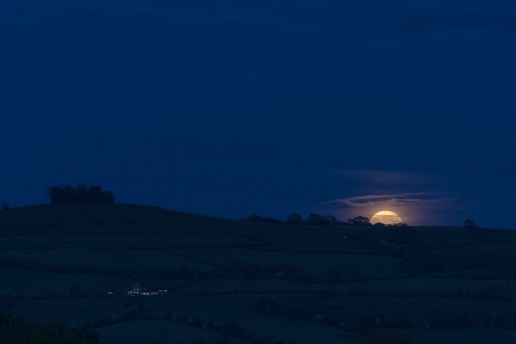
Tim Graham emailed to share two more photos. One is of the Roundhill bathed in rose light floating above a cityscape at dusk – below.

I’ll use the second – a nightscape – to illustrate Jon Hamp’s latest poem (see post below).
Photographers are welcome to share Roundhill photos, and you can see more of Tim’s work, on the Kelston Roundhill Flickr group he started. (Suggest just keep them backed up, given the uncertainties around Yahoo!).
Lay me down gently,
Lay me down slow,
Lay me down here
By the late fire’s glow.Lay me down softly
and ease my sight,
down to the river
This one last night.I brought you no victories
Though you made me your King.
Now small talk of triumph
Seems a meaningless thing.No conquests,
No concubines,
No palace, no gold.
Just this hill and these fields,
Just this night and this cold
that comes up from the waters
far off to the west.So lay me down softly
At the hill’s gentle crest.
Jon Hamp
May 2016
With thanks to Martin Palmer whose research prompted thought about those buried, long ago, on or near the hill.

Click on the pic to see Owain Jones’ photos from the Bath Spa Uni environmental humanities kick off day. Cheers Owain!
Bath Spa’s brand new centre for environmental humanities held its kick-off workshop in the Old Barn on Kelston Roundhill yesterday. Led by Prof Kate Rigby, it’s the first such centre in the UK.
They’re a distinguished and diverse group of academics: geographers, writers, philosophers, poets, educators and more. Some people shared a keen sense of loss of long-associated landscapes – a depopulated island, an eroded coastline, a compulsorily developed farm.
They’re fun to hang out with: they’re interested in everything – reptiles, politics, capitalism, planning, theology – they take photos, like good food and bake cakes. We sat around on pallets, talked a lot, walked up the hill, warmed food on the wood-burner. At midday the group invited in Graham Padfield, founder of the Bath Soft Cheese company who provided delicious cheese for lunch.
 Graham Padfield tells the assembled academics about the laborious tasks involved in running a dairy farm.
When students at the UK’s finest liberal arts establishment Bath Spa University look out dreamily to distant horizons here’s what they see:

Newton Park campus by Capability Brown. Photo of Kelston Roundhill by Prof Owain Jones
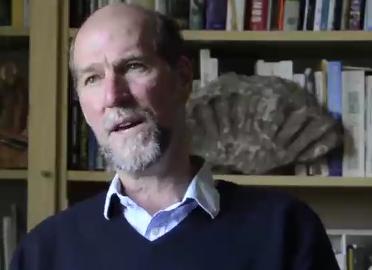
In part three of our conversation, Martin Palmer, director of the Alliance of Religion and Conservation, talks about how the Romans used local fossils, and interprets the Celtic origins of the name “Kelston”.
Behind me is this stone here, part of an ammonite, so probably about 150-200m years old. What’s interesting about it is that I think it was reused by the Romans: it has been clearly cut on this side. This has been clearly trimmed, and there was some cement here – Roman cement.
I think this was used as the rays of the sun behind the head of one of the Roman Gods, and was probably used in a Temple somewhere down here.
Martin Palmer and local ammonite fossil probably reused by the Romans.
This was found on a field in Kelston, and given that probably it would have tumbled down from Kelston Roundhill over the millennia. Most of the fossil strata is about half way up Kelston Hill. If you walk for example on the path going from North Stoke over to Weston where the path passes the hill as you look where the water rushes down you’ll find these everywhere. Or indeed if you come down past George’s farm, down the track leading to Kelston you can find those again.
So you’ve got this fantastic richness of the past. That has always raised for us questions about us as human beings: who are we if this is 140m years old, when all of this was under the sea? It does put the human obsession that the climate should be exactly as we want, rather than as Nature will actually have it, into some kind of perspective.
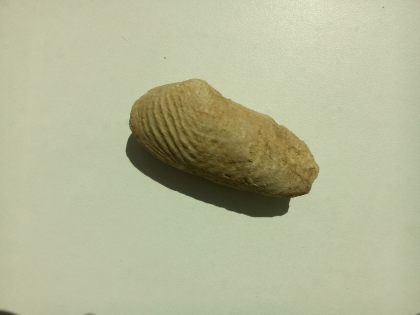
We have always taken what Nature has given us in evocative, in tantalising elements, and have read into it what we want to read. For example I love walking over the fields here and finding or walking down the hills or the lanes and finding these wonderful fossils – sea shells, again going back 140-200m years.
Sea shell fossil found on Kelston Roundhill
What is interesting about these is we know that in Roman times these were considered to be auspicious, and would be put into coffins. And of course there was a series of Roman coffins found by the church here in Kelston – Roman coffins.
It also gives us a very interesting sight on the name of Kelston. Kelston was originally Kelweston in the Anglo-Saxon word, the “Weston” bit being that it was to the west of Bath.
North Stoke is to the north of Bath, South Stoke is to the South, Batheaston…. The “Kel” bit has traditionally been translated as “calf”: where the calves are kept, west of Bath. But I’m not so sure. Cows wander. Far more likely I think is that “Kel” comes from the Celtic word – and the Anglo-Saxon version of that – meaning a church. And that what you’ve actually got is a memory that there was a church here in the late Roman period.
That would explain why the late Roman burials here are Christian. But what is fascinating is that they fused the belief in Christ with a reverence and a respect for what the past and what the hill itself gave. So as it were you have the Holy Land of the Bible, and you have the holy land of this area.
 | Clare Heath on Supermoon pics by Gregg W… |
 | Anonymous on Childhood recollection of Kels… |
| Anonymous on Whisper Our Stories Back: poem… |
| Anonymous on West country meets Ethiopia: t… |
 | Abby Maxwell on Sobering wildlife report from… |

 Kelston Roundhill and Roundhill Barn