“And did those feet…” Kelston vs Kelweston: calves or a church?

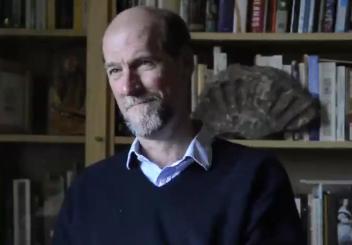
In part three of our conversation, Martin Palmer, director of the Alliance of Religion and Conservation, talks about how the Romans used local fossils, and interprets the Celtic origins of the name “Kelston”.

Behind me is this stone here, part of an ammonite, so probably about 150-200m years old. What’s interesting about it is that I think it was reused by the Romans: it has been clearly cut on this side. This has been clearly trimmed, and there was some cement here – Roman cement.

I think this was used as the rays of the sun behind the head of one of the Roman Gods, and was probably used in a Temple somewhere down here.


ammonite

Martin Palmer and local ammonite fossil probably reused by the Romans.

This was found on a field in Kelston, and given that probably it would have tumbled down from Kelston Roundhill over the millennia. Most of the fossil strata is about half way up Kelston Hill. If you walk for example on the path going from North Stoke over to Weston where the path passes the hill as you look where the water rushes down you’ll find these everywhere. Or indeed if you come down past George’s farm, down the track leading to Kelston you can find those again.

So you’ve got this fantastic richness of the past. That has always raised for us questions about us as human beings: who are we if this is 140m years old, when all of this was under the sea? It does put the human obsession that the climate should be exactly as we want, rather than as Nature will actually have it, into some kind of perspective.

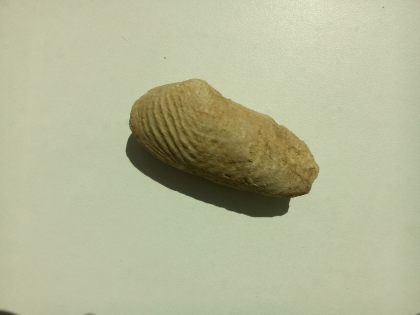
We have always taken what Nature has given us in evocative, in tantalising elements, and have read into it what we want to read. For example I love walking over the fields here and finding or walking down the hills or the lanes and finding these wonderful fossils – sea shells, again going back 140-200m years.

2016-04-30 12.52.24

Sea shell fossil found on Kelston Roundhill

What is interesting about these is we know that in Roman times these were considered to be auspicious, and would be put into coffins. And of course there was a series of Roman coffins found by the church here in Kelston – Roman coffins.

It also gives us a very interesting sight on the name of Kelston. Kelston was originally Kelweston in the Anglo-Saxon word, the “Weston” bit being that it was to the west of Bath.

North Stoke is to the north of Bath, South Stoke is to the South, Batheaston…. The “Kel” bit has traditionally been translated as “calf”: where the calves are kept, west of Bath. But I’m not so sure. Cows wander. Far more likely I think is that “Kel” comes from the Celtic word – and the Anglo-Saxon version of that – meaning a church. And that what you’ve actually got is a memory that there was a church here in the late Roman period.

That would explain why the late Roman burials here are Christian. But what is fascinating is that they fused the belief in Christ with a reverence and a respect for what the past and what the hill itself gave. So as it were you have the Holy Land of the Bible, and you have the holy land of this area.
Posted in Uncategorized | Leave a comment

Kelston Roundhill today 29 April 2016

Kelston Roundhill

Photo by Tim Graham

Posted in Uncategorized | Leave a comment

“It’s 3am on Moorland Road” by Jon Hamp

It’s 3 am on Moorland Road

The lamplight strips the scene

A trail of blood and bottles

Shows where the tribe has been

A fox shakes his head from the alley

and slowly takes his bow

It’s 3 am on Moorland Road

How dark is Kelston now?


How dark is the night on the hillside?

How dark on the lonely track?

How dark in the woods on the valley edge?

How dark on the Camel’s back?


A breeze moves the grass on the western approach,

a pebble shifts its weight,

the fence posts stretch out in the darkness,

to carry the broken gate.

The dark and stillness triumph, as much as man allows

Its 3am on Moorland Road

How dark is Kelston now?


by Jon Hamp, 2016

Posted in Uncategorized | Leave a comment

Tim’s new “Kelston Roundhill” Flickr group

Tim Graham has started a new Kelston Roundhill Flickr group with a dozen terrific images. He writes

Kelston Roundhill is one of my favourite places & I’ve been somewhat of an amateur photographer for the last 2 years so I’ve tried to combine my passions.  Thought it would be good if you could make others aware of the group so they can add to it…I’ve seen the photos on your website. They’re great & certainly give me inspiration.


Well worth joining if can bear going through Yahoo/Flickr’s intrusive and clunky account sign-up procedure. Funny to think it might all be part of the Daily Mail soon.


Sunrise over Kelston Roundhill

Sunrise over Kelston Roundhill

So…do we reproduce more of Tim’s images here? Or point other photographers towards Tim’s Flickr group? What a Web 2.0 dilemna. But keep them coming! We’re surely headed toward some sort of “collected photos and poems of Kelston Roundhill” here.

Storm over Kelston

Storm over Kelston

Posted in Uncategorized | 2 Comments

Defence, shrine or a place for storytelling? The mystery of the Roundhill’s ancient uses

What was this hill used for in ancient history? Is there evidence, or do we have to guess? In part two of a series, the artist Penney Ellis and I put these questions to the environmentalist and religious historian Martin Palmer.

Mostly we have to infer, and the name Henstridge gives us a very powerful inclination. I think also the fact you are producing a blog about this hill indicates that in some way or another this hill still evokes a very different sense from say just Lansdown for example.

There is something about it that evokes a response. The big issue which has never been satisfactorily answered is whether the top of Henstridge – of the Roundhill – is actually an ancient burial site, an ancient settlement, possibly an ancient temple.

Martin2

Before the copse of trees was planted on there, prior to that in 1798 we have an account of the Roundhill in which the author says it clearly is the site of a tumulus – a burial mound or burial mounds. The trouble is that having been dug up to plant trees most of the evidence has probably been destroyed.

To the best of my knowledge I’m not sure there’s ever been a full archaeological excavation up there. It would be a logical place for there to be at the very least a watchtower. It’s not so much a logical sort of place for burials, because burials tend to be not on the tops of hills but on the edge of hills. This is because they were markers. There are a couple of burial mounds just by Prospect Stile which looks across to Kelston Roundhill. They’re set at an angle to the hill. Really these were markers to say “sorry folks you may be looking for good agricultural, land but this land is taken. Our ancestors are protecting it. Go away.” So Henstridge doesn’t have for me the feel of a burial mound. It does have the feel of a defensive site, but also of a spiritual site.

Qu: So do you think the right thing to do would be to investigate without any real certainty as to what we might find, just to see what’s there?

I would do two things. Yes I think it would be fascinating to explore and see what could be found. But I think the power of a place like Henstridge Hill, and the power of naming, is the stories we can make up about it. A powerful sacred site, a powerful physical feature, draws out of us stories that are about us, that are about our relationship with nature, that are about our relationship with the past and therefore with the future.

So part of what I’d like to see happen there is that it becomes a focal point for storytelling – for contemporary storytelling; for storytelling about what are we, who should we be?

My guess is that the physical features of this astonishing hill have long evoked a sense of reverence, a sense of storytelling.

Posted in Uncategorized | Leave a comment

What’s in a name? Martin Palmer says why he prefers “Henstridge”.

The environmentalist and religious historian Martin Palmer, founder of the Alliance of Religion and Conservation, is a quiet genius based in Bath (and until recently Kelston). His book Sacred Land: Decoding Britain’s Extraordinary Past kicked off his Sacred Land project to help people rediscover the deeper qualities of the landscape around them.

The artist Penney Ellis and I went and asked him about the Kelston Roundhill. We started by asking him about the name itself. Here’s what he said about that (transcribed by me, E&OE):

It has two names. The most popular name – the name most people know and you“ll see on the maps – is “Kelston Roundhill”. That is is absolutely accurate. It is a very dramatically round hill; it rises above Kelston. But it’s a late Georgian or Victorian name, more concerned with describing than with evoking.

Martin1

It’s original name – and the only trace of this now is the barn in the village here called Henstridge Barn – is Henstridge. Now Henstridge is a far more interesting name than Kelston Roundhill. I confess I’m somewhat biassed here.

Henstridge means “the hill of the stallion”. And – this is speculation, but I think it“s valid speculation – in Celtic mythology the horse was the most powerful symbol, both of new life and regeneration, but also of war (think for example of the white horse at Uffington on the Berkshire Downs, just below Uffington Castle). So this was a power place. It was a place you would gather the tribes together around you; your symbol.

One of the most astonishing things about Kelston Roundhill is you can stand in the centre of Bristol and it’s the only natural feature you can see, apart from Dunbury Hill. It stands out. It is remarkable. You can see it for dozens of miles away. Clearly it has always been a significant hill.

fromAshtonParkBristolThe Roundhill seen from Ashton Park, Bristol (photo by Owain Jones) 
What I think “Henstridge Hill” tells us is that this was a rallying point for the tribes – certainly in the Celtic period when the horse was enormously significant. It was also to do with this notion that the horse was given complete freedom to roam, a tradition that comes from India. Remember that the names of our oldest features here we share with Sanscrit – Sanscrit names of rivers and hills abound in Britain. So we share one tradition which went into India in one direction and came across to Europe in the other.

In the Indian Vedic tradition the horse is the symbol of the freedom of the tribe. One of the traditions was that when there was a dispute you would bring a horse to a high point and the horse would be let free. And where the horse went, the tribe had the right to go. But it also becomes this standard you would raise when you were under threat. And so my sense is that Henstridge hill was the rallying point for the tribes and the clans that lived around here, certainly in the Celtic period.


Posted in Uncategorized | 3 Comments

“A girl walks a dog…” by Jon Hamp

A girl walks a dog
To the crest of the hill
Her thoughts of word unspoken.

The last flags of day are torn on the west,
And all the clouds are broken.

Once, a day was a wave through the corn ,
A breeze across the sand.
I can hear the harbour wall sigh
From 40 miles inland.

Jon was born in upper Weston in a house looking out on the Roundhill. It was one of his earliest walks, and hillwalking later took him to Skye, the Pyrenees, and the Himalayas. “You should never forget your first summit or where you started,” he writes. “I couldn’t ‘log’ Kelston as significant when I qualified as a mountain leader but it was always in mind.” He now lives back in Bath, and once again has a view of Kelston.

Posted in Uncategorized | Leave a comment

Bath Spa and the UK’s first centre for environmental humanities

Bath is now home to the UK’s first Centre of environmental humanities. It’s part of Bath Spa University’s strategic vision to become the UK’s pre-eminent University for the liberal arts. Bath Spa is already active in a new global grouping of like-minded institutions.

Government and the chattering classes go on about STEM but liberal arts are key. STEM alone won’t ensure our survival. Environmental humanities covers the history, philosophy and culture of our ecology and how we understand it. One precursor is the work on spirit of place of our dear neighbour Martin Palmer at the Alliance of Religion and Conservation

2016-03-28 12.31.01

Profs Kate Rigby & Owain Jones enjoy a sharp sou-westerly on Kelston Roundhill. 

So it was delightful and appropriate to be able welcome Bath Spa’s two Professors of Environmental Humanities Kate Rigby and Owain Jones to Kelston Roundhill on Monday, just as Storm Katie was brewing up a full blast.

Kate has just arrived from Melbourne to lead the Centre and help develop an associated Masters programme (see press release).

Owain is thoroughly local, with links to family farming and a deep knowledge of the local landscape, initiatives and cultural institutions. For more info see his blogs Environmental HumanitiesTidal Cultures and Sonic Severn.

See Owain’s photos from the visit on Flickr.

Posted in Uncategorized | 2 Comments

March afternoon to evening gently pass…

…with light on fossiled stone through chiselled grass

Words & photo by Jon Hamp

Posted in Uncategorized | Leave a comment

Maintaining the Clump (Mark Strutt letter to parish council)


Clearing out some files I came across this 2013 letter from our original land agent Mark Strutt, drafted for the parish council mag. I’ve no idea whether it was ever published, so let’s put it here. It’s good explanation of what we’re working our way through at the Clump.

The owners of Roundhill Farm have been concerned for some time as to the well being of the Roundhill Wood, ‘The Tump” which, as you all know, forms a very prominent local landmark.

Over the years, the wood has been declining and is in danger of disappearing completely unless it is managed to allow natural regeneration and new trees and shrubs are planted.  It has also suffered from a degree of abuse and vandalism in the form of fires set against the trunks of trees and litter scattered across the site.

The owners are now undertaking a programme of regenerative management to ensure the future of the “Tump” for the enjoyment of the local communities and the many visitors to the “Tump”.

This will consist in the first instance of some site clearance to remove dead decaying and dangerous trees and the old barbed wire fencing.  New under-planting with shrubs and  native hardwoods will take place along with the encouragement of natural regeneration.  In order to protect the new planting, and to allow the natural regeneration to get established, it will be necessary to exclude deer and sheep, and to protect the new planting with spiral guards against rabbit damage.

To this end, a temporary deer fence will be erected and remain in place until the new trees are sufficiently established so as not to be vulnerable to deer predation.  Once that is achieved, the deer fence will be removed, leaving a traditional parkland iron railing fence in place to exclude sheep and cattle.

At the same time, the owners propose to enter into a new Permissive Path Agreement with Bath and North East Somerset Council, the existing one being time expired, to maintain the thee existing permissive paths, (two off the Cotswold Way  and one  off Cullimore’s Lane (aka “Fred’s Lane”). There will be some realignment of the South East Path off the Cotswold Way to align it with the existing hedge.  Plans will be submitted to BANES shortly and they will be copied to the Parish Council / amenity groups for comment before the new agreement is signed off.

Roundhill is mainly grazed by sheep.  There have recently been a number of incidents concerning loose dogs and sheep.  It must be understood that if these incidents continue, the owners will have little option but to consider closure of the permissive paths when sheep are present on the Roundhill unless dog owners keep their dogs under control, which  means on a lead.  This closure would be an unfortunate step to take and will cause disappointment to many visitors, so we urge all to help and to ask dog owners who do not abide by the Countryside Code to do so.

Litter has been and is a continuing problem. It is unpleasant for visitors and a danger to livestock.  Whilst many observe the rule to remove litter, some do not.  Please encourage anyone seen dropping litter to remove it.

Looking after the Roundhill is a task that  falls to all who visit it as well as the Owners.  We would like to hear from anyone who would like to become actively involved on a “warden / volunteer” basis to help look after this important and prominent feature.

Mark Strutt had to retire on health grounds soon after. We much miss his expertise and crisp, military manner.

Posted in Uncategorized | Leave a comment