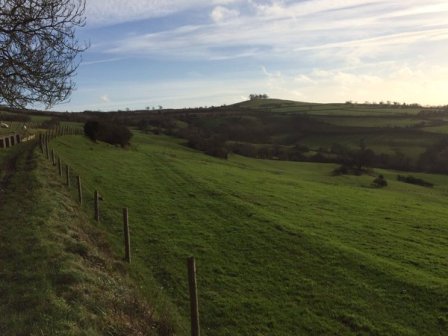
…with light on fossiled stone through chiselled grass
Words & photo by Jon Hamp
Clearing out some files I came across this 2013 letter from our original land agent Mark Strutt, drafted for the parish council mag. I’ve no idea whether it was ever published, so let’s put it here. It’s good explanation of what we’re working our way through at the Clump.
The owners of Roundhill Farm have been concerned for some time as to the well being of the Roundhill Wood, ‘The Tump” which, as you all know, forms a very prominent local landmark.
Over the years, the wood has been declining and is in danger of disappearing completely unless it is managed to allow natural regeneration and new trees and shrubs are planted. It has also suffered from a degree of abuse and vandalism in the form of fires set against the trunks of trees and litter scattered across the site.
The owners are now undertaking a programme of regenerative management to ensure the future of the “Tump” for the enjoyment of the local communities and the many visitors to the “Tump”.
This will consist in the first instance of some site clearance to remove dead decaying and dangerous trees and the old barbed wire fencing. New under-planting with shrubs and native hardwoods will take place along with the encouragement of natural regeneration. In order to protect the new planting, and to allow the natural regeneration to get established, it will be necessary to exclude deer and sheep, and to protect the new planting with spiral guards against rabbit damage.
To this end, a temporary deer fence will be erected and remain in place until the new trees are sufficiently established so as not to be vulnerable to deer predation. Once that is achieved, the deer fence will be removed, leaving a traditional parkland iron railing fence in place to exclude sheep and cattle.
At the same time, the owners propose to enter into a new Permissive Path Agreement with Bath and North East Somerset Council, the existing one being time expired, to maintain the thee existing permissive paths, (two off the Cotswold Way and one off Cullimore’s Lane (aka “Fred’s Lane”). There will be some realignment of the South East Path off the Cotswold Way to align it with the existing hedge. Plans will be submitted to BANES shortly and they will be copied to the Parish Council / amenity groups for comment before the new agreement is signed off.
Roundhill is mainly grazed by sheep. There have recently been a number of incidents concerning loose dogs and sheep. It must be understood that if these incidents continue, the owners will have little option but to consider closure of the permissive paths when sheep are present on the Roundhill unless dog owners keep their dogs under control, which means on a lead. This closure would be an unfortunate step to take and will cause disappointment to many visitors, so we urge all to help and to ask dog owners who do not abide by the Countryside Code to do so.
Litter has been and is a continuing problem. It is unpleasant for visitors and a danger to livestock. Whilst many observe the rule to remove litter, some do not. Please encourage anyone seen dropping litter to remove it.
Looking after the Roundhill is a task that falls to all who visit it as well as the Owners. We would like to hear from anyone who would like to become actively involved on a “warden / volunteer” basis to help look after this important and prominent feature.
Mark Strutt had to retire on health grounds soon after. We much miss his expertise and crisp, military manner.
There’s a timely warning from West Yorks Police on an issue that affects us and neighbouring farms:
It has come to our attention that there has been several incidents recently of livestock worrying and destruction of livestock in farmer’s fields in the Bingley area.
West Yorkshire Police would like to inform the public of their personal responsibilities of making sure your beloved pet is always under appropriate control when it comes to walking your furry friend over agricultural land.
Some agricultural land have designated public bridleways running through them. This means that even though there is public access, you are restricted to adhere to the bridleway and not the use of the entire field.
Under the laws contrary to section 1 of the Dogs Act 1953 (Protection of Livestock), you are liable to prosecution if your dog is worrying livestock and you are not in proper control of your dog.
Worrying livestock means :- attacking livestock or chasing livestock in such a way that it may reasonably be expected to cause injury or suffering.
Livestock means :- sheep, cows, goats, horses and poultry.
Sheep and cows are timid creatures who only have a simple existence, to eat grass, breed further animals and rear them in peace.
Please could we remind all dog walkers who enjoy these rural routes to make sure that when walking through agricultural land with your pet, please keep the dog on its lead.
Dogs running wildly around in a field of sheep and cattle worries these animals.
Please be aware that a farmer does have the fundamental right to protect their livestock as they are a business (Animals Act 1971).
Well put. What’s true in Bingley is true in Bath. I’ve seen many episodes of ill-controlled dogs on the Roundhill and nearby farms. Farmers generally like dogs and don’t want to shoot them. But I’m aware of three local episodes where very local farmers have shot dogs dead. One had seriously injured a sheep. One would not stop attacking a cow (sic). One incident was decades ago, but still significant because the rancour it caused persists to this day. Control your dogs people.
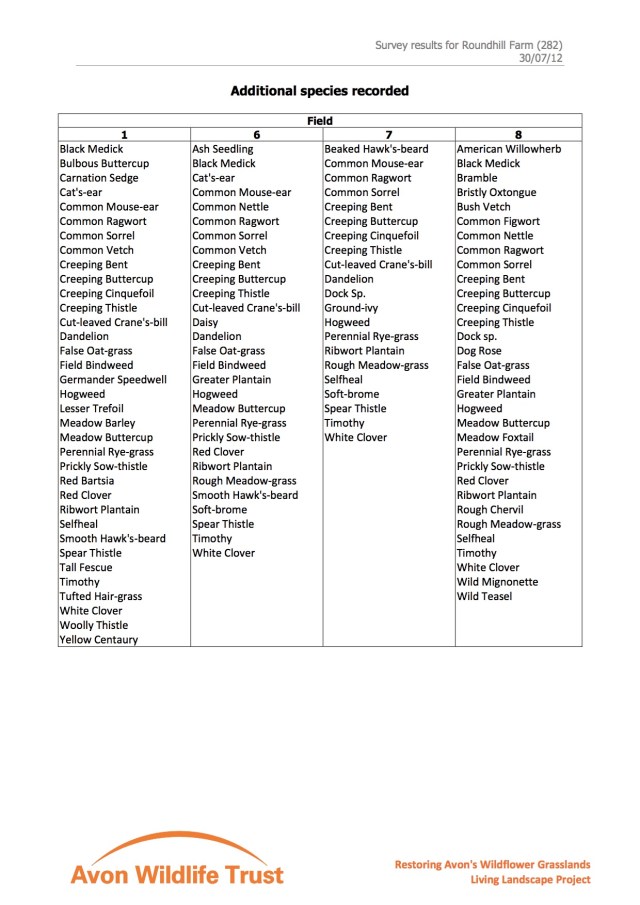
A couple of years back we had Avon Wildlife Trust do a species survey of the Roundhill grassland. Seems worth publishing here; let’s see if it changes or if there’s anything visitors can add to it. Full original pdf is here.
Key:
1: Roundhill (ie N,W&E of the Clump)
6: top of Barrows Style
7: bottom of Barrows style
8: lower Horse Ground
F = frequent: found at 5 or more out of 10 survey points
O = occasional: 3-4 out of 10 survey points
R = rare: up to 2 out of 10 survey points
Y = yes, present but not recorded at the 10 survey points

You can now download a floor plan for the Old Barn here.
We were on the path from The Swan Inn at Swineford to North Stoke, and it was lost somewhere along the path on the way back. The Lumix camera was in a black camera bag with a strap.
Here’s a heart-warming story from last summer on the Roundhill. Jade writes:
Since being at primary school, I’ve always had a fascination with Kelston Roundhill which has continued into my early 20’s. My dad told me for years that he’d take me to the top of the hill, but I’m still waiting!
About a year ago, me and my partner decided on a Sunday adventure with our dog to get to the top of Kelston Roundhill and wow…I’m so glad we did. The views are just stunning and our dog loves it! Since then, it has been our favourite place to go and I love being able to see it from our home in Hanham and on my daily commute to work.We love it so much in fact, that last Friday 31st July my partner surprised me with a proposal at the top of the hill! So Kelston Roundhill is even more special to us.

Congratulations both!
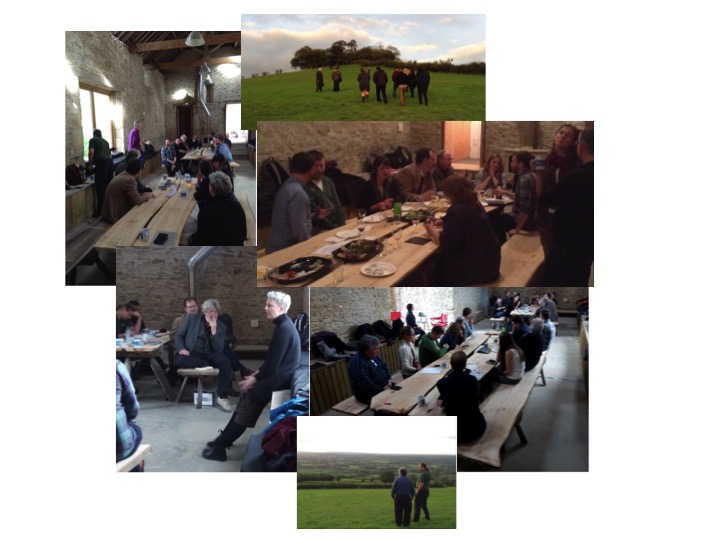 The old barn on Kelston Roundhill is finding a new purpose threshing ideas, as Graham Padfield puts it so well in his poem The Barn on the Hill. The old name for Kelston Roundhill is Henstridge Hill, the “gathering place of stallions” in time of need. Last week a bunch of us who work on digital ideas felt the need for a gathering of the clans.
We met because while massively optimistic about the possibilities of the digital world or information age we share some concerns:
The concerns are well expressed for example in Sarah Gold’s TEDx talk or Martha Lane Fox’s Dimbleby lecture. There are many insights to be had from the experiences of the Government Digital Service GDS. Martha’s dotEveryone project expresses the ambition to make Britain brilliant in the digital age. If that’s to happen we need to understand the problems and know what each of us can and should do about it in practice.
It was wonderful. The tribe gathered. The location, setting, furniture, food, walk worked. A good time was had by all. In terms of concrete results the afternoon produced excellent and clear problem statements, and many memorable epithets – see below.
If you want to use the Old Barn at Kelston as a workspace for threshing ideas or a bunkhouse click here or email kelstonroundhill@gmail.com.
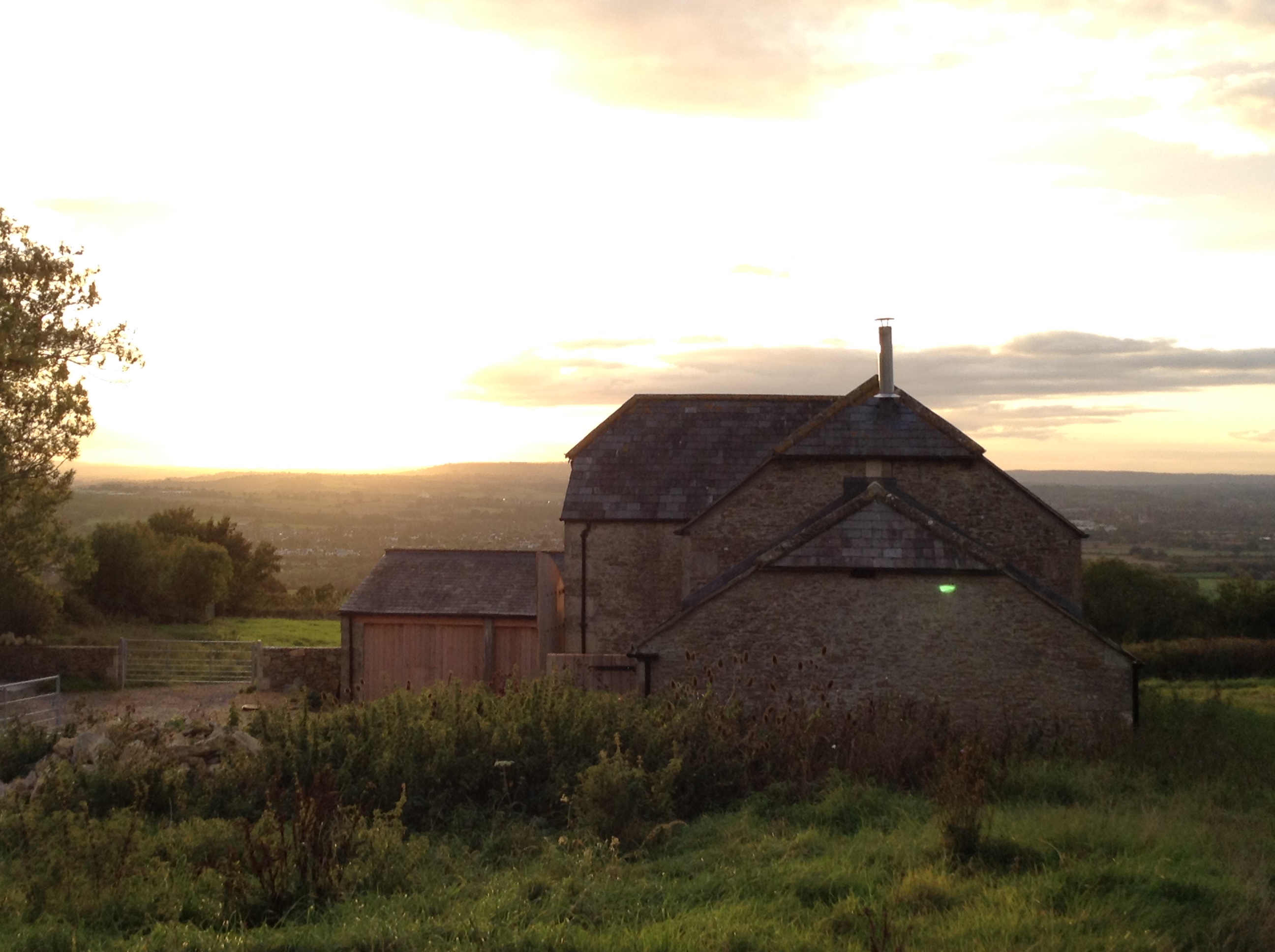
Photo by Sarah Prag
Below the hill, where buzzards glide,
All alone the stone barn lies,
And people walking care not why
The barn’s alone and still.
The barn has seen splendid times
When masons made her walls with lime,
To garner grain to grind
From fields upon the hill.
Men and boys and wagons wheeled
Hauled the sheaves from nearby fields,
And thrashed the crop between tall doors
The produce of the hill.
Across the floor, the wind’s cool draught
From heavy grain lifted chaff
That floated on the sunlit shafts,
Until the barn was filled.
Now the fields around the barn,
Too steep and small for growing corn
Grow grass for cows on valley farm
And sheep across the hill.
The waving wheat no longer yields
Head heavy sheaves from stubble fields,
Hauled on wooden wagon wheels,
That creaked across the hill.
So empty now the barn it lies,,
No more the flails and shovels fly.
The old slates slip, and slowly slide
To rest upon the hill.
On the beams step pairs of doves,
Cooing, keening, making love,
As if they, to the barn, must prove
There’s still life on the hill.
But Fortune’s wheel turns around
And better uses must be found
Than lying empty ‘mongst the sounds
Of nature on the hill.
Builders come with latest tools,
Installing bunks and showers and loos,
For the convenience of those who choose,
To walk upon the hill.
To breathe the air and drink the view,
Philosophise and be improved,
Above the valley’s buzz and hue
And venerate the hill.
So the barn that’s watched the country age
Now finds itself at centre stage,
So young and old henceforth engage
In the story of the hill.
 | Anonymous on Welcome to Kelston Roundhill!… |
 | Clare Heath on Supermoon pics by Gregg W… |
| Anonymous on Childhood recollection of Kels… |
| Anonymous on Whisper Our Stories Back: poem… |